
Other Services
Radon Inspection and Testing Services in Chicago
Radon is a naturally occurring radioactive gas. You cannot see it, smell it, or taste it, but its long-term exposure is the leading cause of lung cancer in the United States among non-smokers. The EPA recommends that every home be tested for radon, regardless of age or construction type. Sabreez Home Inspection provides certified radon gas inspection services in Chicago, including commercial radon inspection for businesses and investment properties.
What a Radon Home Inspection Involves
Testing for radon is not complicated, but it needs to be done correctly to produce reliable results. Our radon inspection process begins with placing calibrated radon detectors in the lowest livable area of the home, which is the basement or the first floor if there is no basement. This is where radon concentration is typically highest.
For short-term testing, the device remains in place for a minimum of 48 hours under closed-house conditions. Closed-house conditions mean windows and doors are kept closed to prevent air exchange from affecting readings. After the test period, results are analyzed and documented in a written report. If radon levels in your home register at or above 4.0 pCi/L (picocuries per liter), the EPA recommends taking action to reduce radon levels.
For long-term testing (90 days or more), results reflect seasonal variation and provide a more accurate picture of average annual radon exposure. Long-term testing is the more accurate method when time allows.
Radon Concerns Throughout Chicago and Illinois
EPA Radon Zones and Local Risk
The EPA classifies radon risk by county across the United States. Illinois has a significant number of counties in EPA Zone 1 in the northern and central parts of the state, which is the highest risk category. Areas like Normal, Bloomington, and the greater Chicago metro have documented elevated radon levels in residential properties.
Geological Factors
Radon forms from the natural decay of uranium and radium in soil and rock. The underlying geology in much of Illinois consists of glacial deposits, limestone, and granite bedrock in some regions. It produces radon gas that migrates upward through the soil. Properties built on or near these geological formations tend to have a higher radon concentration.
Why Radon Testing Is Recommended Regardless of Home Age
Newer homes are not necessarily safer from radon. In fact, tighter construction and better insulation can actually trap radon more effectively than older, leakier buildings. Radon levels in your home reflect the soil conditions beneath the foundation rather than the age of the building above it. This is why the EPA recommends testing every home.
Seasonal Fluctuations
Radon levels fluctuate throughout the year. In winter, when homes are tightly closed and heating systems create negative pressure, radon tends to accumulate at higher levels. This is one reason that long-term testing provides a more complete picture. A short-term test conducted in summer may underestimate winter-peak radon exposure.
How Radon Enters Homes Through Foundations and Basements
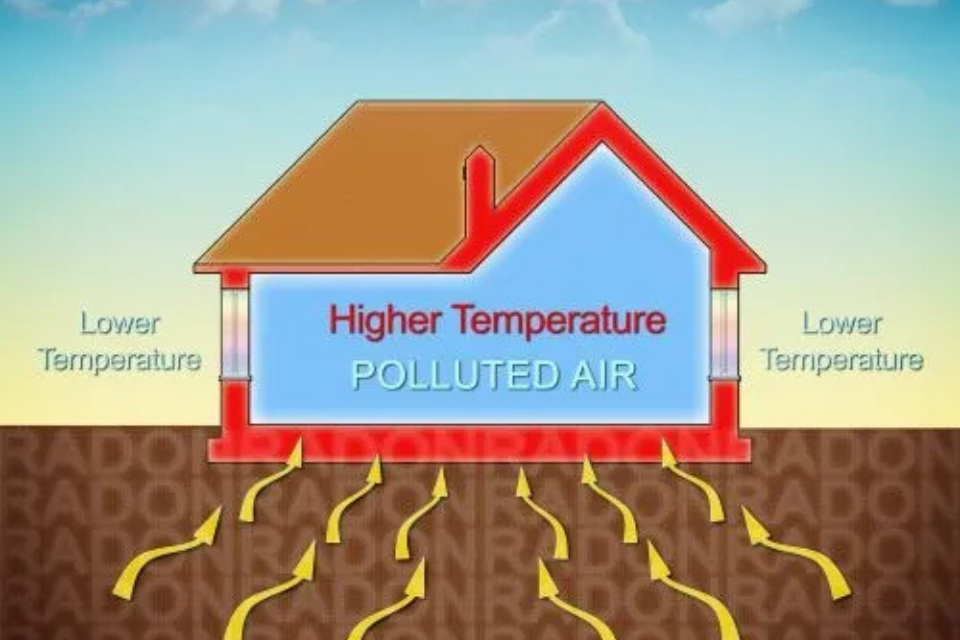
Radon moves through the soil as a gas and finds its way into buildings through any opening at or below grade. Understanding the entry points helps explain why some homes have high radon levels even without obvious structural problems.
Foundation cracks are the most common entry point. Poured concrete and block foundations develop cracks over time from settlement and thermal movement. Radon seeps through these gaps even when they appear minor.
Sump pits and sump pumps create a direct opening through the floor slab to the soil beneath. Radon-laden air from the soil enters through the sump pit and rises into the basement. Open sump pits in particular are a significant radon entry pathway.
Utility penetrations — where plumbing, electrical conduit, and gas lines enter the foundation — often have gaps around the sleeve or opening. These small gaps allow continuous radon movement from the soil into the structure.
Crawl spaces accumulate radon from soil exposure across the entire crawl area. Without a sealed vapor barrier and adequate ventilation, radon migrates from the crawl space into the living space above. Homes with dirt-floor crawl spaces tend to have elevated radon levels.
Concrete floor joints and hollow block walls allow radon to move laterally and upward through the structure. Block foundation walls in particular act as channels for radon migration when the wall cores are open to the soil.
Understanding these pathways matters because it informs where radon mitigation efforts — typically a sub-slab depressurization system — need to be directed. If your test results exceed 4.0 pCi/L, we provide radon mitigation recommendations and referrals to qualified contractors who can install a radon mitigation system.
Frequently Asked Questions — Radon Inspection in Chicago
What is a radon inspection?
Is a radon test required in a home inspection?
How much does a radon inspection cost?
Do new homes need radon inspection?
How long does a radon inspection take?
Contact Sabreez Home Inspection for radon gas inspection and testing in Chicago or anywhere across Illinois: (773) 312-2511
Auxiliary Services Bundle = 30% Off If Services Are Conducted At The Same Time As The Home Inspection
As a valued customer, we offer you auxiliary add-on services. By bundling one auxiliary inspection with a regular home inspection, you’ll receive a minimum 20% discount on any additional inspections, provided they are completed on the same day.
NOTE. #6-7 aren’t included in 30% BUNDLE, but are included under auxiliary services
Get Your Free Radon Inspection Quote Now
Your trusted Radon testing home inspection services in Chicago, IL are here to help. Whether you’re just beginning the home-buying process or need a routine check-up, Sabreez Home Inspection makes it simple and transparent from start to finish. Call us now, drop an email, or fill out the provided form, and we will get back to you in no time.